
Union County Court Docket Searches
Start any Union County court docket search at the North Carolina eCourts Portal. Its Smart Search tool finds a public case two ways. Enter an exact case number. Or type a party name in Last, First order. The tool also offers other search types, like Citation Number and Business Name. Filters can trim a statewide result to Union alone. A case number is the sharpest tool when court paperwork shows one. For a name search, spell carefully and apply the location filter.
One caution applies. The Portal is a research tool, not the official record. Results open a Register of Actions, sometimes labeled Case Summary. That view shows public information in the system. When a result is missing, a date matters, or a certified document is required, turn to the Union County Clerk of Superior Court. That one office holds both District and Superior Court files for the county.
- Open Smart Search and choose the search type that matches the information in hand.
- Enter an exact case number when available, or enter a party name as Last, First.
- Set the location to Union and add a case type or status only when it helps narrow the result.
- Open the public Case Summary to read its Register of Actions, events, hearings, and dispositions where shown.
- Use the official calendar or clerk when a setting, copy, payment question, or restriction needs confirmation.
Note: Broad searches stop at 200 results. If a Union County docket search returns that many, narrow the query instead of repeating the same generic attempt.
Union County Court Docket Portal
eCourts splits its work into separate tools. Each answers a different question. Smart Search handles a case lookup. Hearing Search works from location, hearing type, search type, and a From and To date range. Judgment Search runs on its own type, status, location, and date filters. Keeping these tasks separate prevents mix-ups. A calendar result might otherwise be mistaken for a full Union County court docket. A judgment index might be read as a current payoff.
The official North Carolina eCourts service page also separates the public Portal from File & Serve, the electronic filing system, and Guide & File, the guided form service. Union County joined eCourts on October 14, 2024. Older instructions may still describe earlier workflows. Current Union County court docket access runs through the Portal and the county clerk.
The eCourts service map shows the state services that now support Union County court activity.
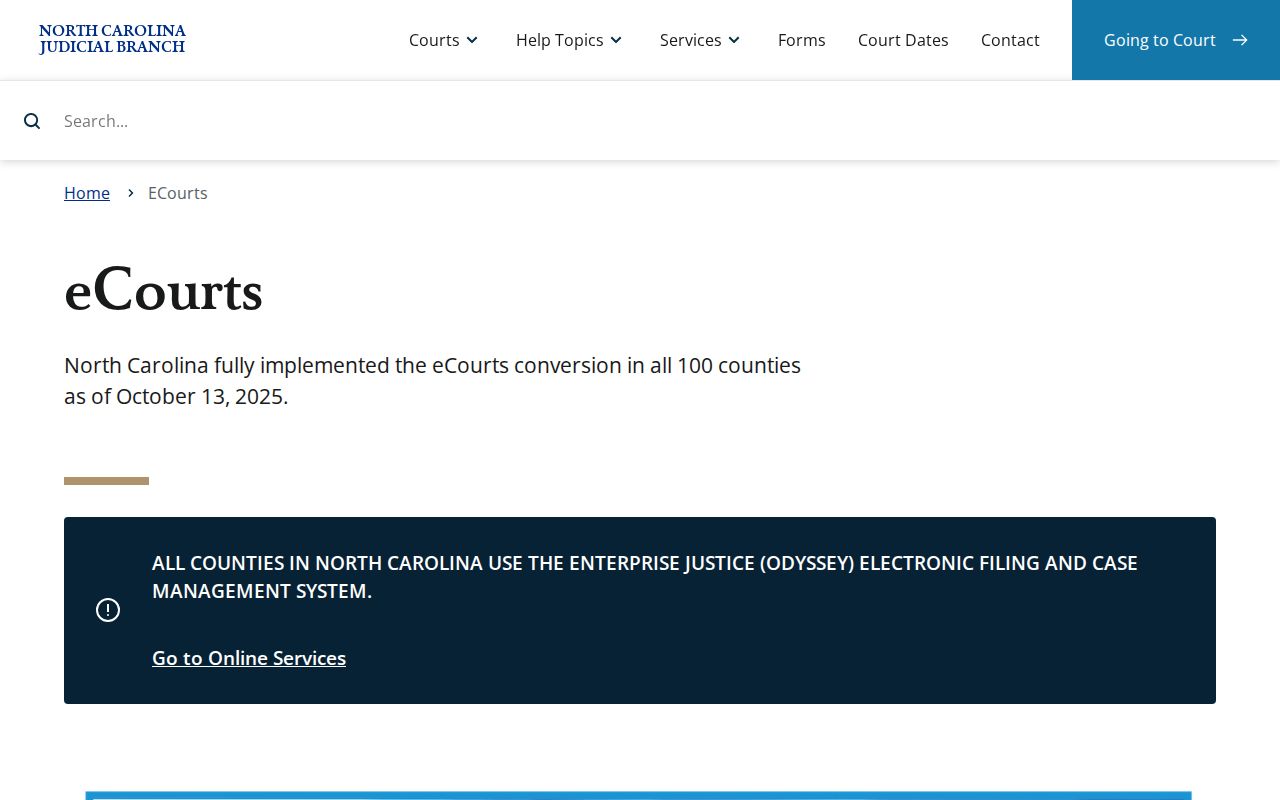
That statewide layer helps with access. Still, the official Union County case file lives with the clerk.
Court Dockets: What They Show
In Union County, the public case display is best called the Register of Actions, or ROA. The Portal may label it a Case Summary. Either name points to a chronological case display. That display is not the same thing as a daily court calendar. An ROA can show identifying case context, event entries, hearing information, a disposition section, and financial information. Those appear when the data exist. Not every public case displays every section. A blank field does not prove a case fact is missing.
| Case Information | File number, type, status, and the court or location context. |
|---|---|
| Case Events | Dated procedural entries in the public Register of Actions sequence. |
| Hearings | Scheduled or recorded hearing data, including a type or courtroom when shown. |
| Dispositions | Recorded outcome or status entries that should be read with the event history. |
| Financial | A section that can appear when data exist, not a current payoff calculator. |
The Portal FAQ warns that its display is not the official record. For certified proof, a correction-sensitive question, or anything needing formal authentication, get a clerk copy.
Union County Court Docket Terms
Short labels appear on a Union County court docket. They show how the system classifies a case or event. They do not settle anything about a person. A status is a procedural label, nothing more. A hearing entry may mark a setting rather than a final result. The terms below offer the most useful distinctions for reading a public Case Summary without overreading it.
- Register of Actions
- The public case-level chronology displayed through the Portal.
- Case Summary
- A Portal label associated with the ROA and case information view.
- Case event
- A dated procedural entry listed in the ROA.
- Disposition
- A recorded decision or outcome entry that needs its surrounding case context.
- Setting
- A scheduled court event; confirm it through live hearing or calendar information.
Once the task is clear, the county docket search page walks through names, numbers, and filters in more depth.
Union County Courts and Their Dockets
Union County sits inside North Carolina's unified Judicial Branch. There are no separate city court systems. Superior Court and District Court both operate at the county level. They share the Clerk of Superior Court structure. Which division takes a matter depends on the case itself. It makes no difference whether the matter arose in Monroe, Indian Trail, Waxhaw, Stallings, or Weddington. Live case information confirms the actual assignment better than anything else.
| Court layer | Union County docket scope | Public research route |
|---|---|---|
| Superior Court | Felonies, civil actions over $25,000, and qualifying District Court criminal or infraction appeals. | Portal, Union calendar, and clerk file. |
| District Court | Misdemeanors, infractions, smaller civil matters, family matters, juvenile matters, and magistrate work. | Portal, Union calendar, and clerk file. |
| Magistrates | Assigned District Court functions, including certain small claims and minor-matter duties. | Clerk or Portal where public, not a separate city database. |
North Carolina District Court information covers the trial division that usually handles infractions and ordinary misdemeanors.
That division structure explains why a traffic or misdemeanor record needs no separate Union County municipal court search. The county courts hold those dockets.
Union County Court Docket Calendar
A Union County court docket tracks case events. A calendar lists a session or hearing date. The two often work together, yet they answer different questions. The Portal's Hearing Search accepts Union as the location. Add a narrow date range and a hearing type such as Civil, Criminal, Family, Probate, or Mental Health. For current civil and criminal session routes, the official court calendar pages are the place to look.
Three links cover the routes. Use Court Dates for the statewide date search. The Union civil calendar covers civil sessions, and the Union criminal calendar covers criminal sessions. Weather, scheduling, and case activity can push a date around. When a setting truly matters, confirm it with the clerk.
Court Dates and Settings in Union County
What does a docket entry about a hearing actually tell you? It can carry the date, the time, and the courtroom. It may also include the hearing type, the judicial officer, and the case reference. That is a setting, not a result. Check the live calendar or the Hearing Search close to the day of the event. A calendar never replaces the case-level ROA. An older setting proves nothing about whether a new one was entered. If an online entry clashes with your court paperwork, call the clerk. Pick the reliable source, not the easy one.
For Union County, the official court location page gathers local services, calendars, and court-date tools in one spot. It works well when you know the case type but not the current session.
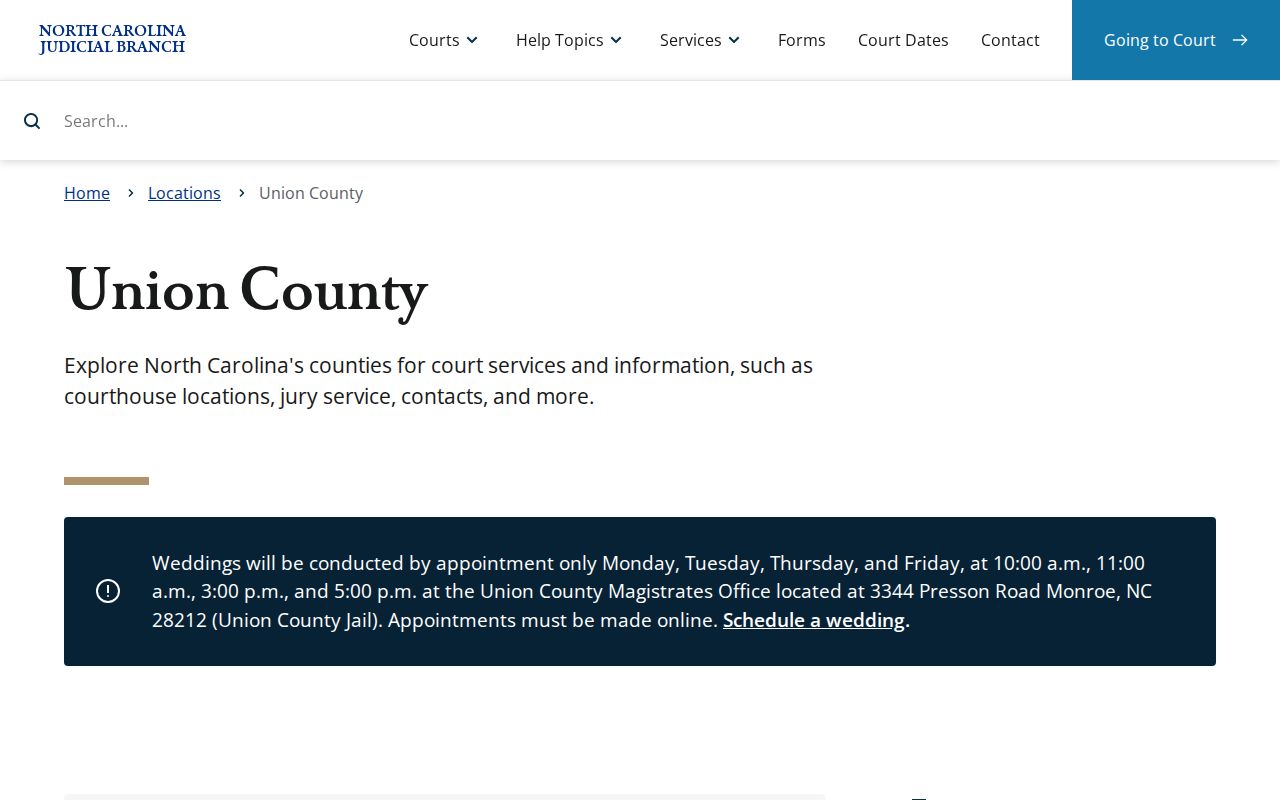
The local court page stays current, tying calendar and county service links to the active Union County court system.
Union County Court Docket Access Points
Online tools are only one way in. The Union County Judicial Center houses the clerk and the trial courts. You will find it at 400 North Main Street in Monroe. It is open to the public on weekdays from 8:30 a.m. to 5:00 p.m. according to the Judicial Branch. Call (704) 698-3100 for the general line. State guidance allows public searches at clerk-office terminals. Union received eCourts public kiosks offering Portal access, filing links, payment services, scanning, and printing.
Ask the kiosk floor when you arrive, since visit-day procedures vary. If a detail matters, a quick phone call first saves the trip. Need to inspect a court file? Want to order ordinary copies or certification, or sort out a Portal discrepancy? The clerk counter handles all of that locally.
The Judicial Center's official page publishes the courthouse contact details.
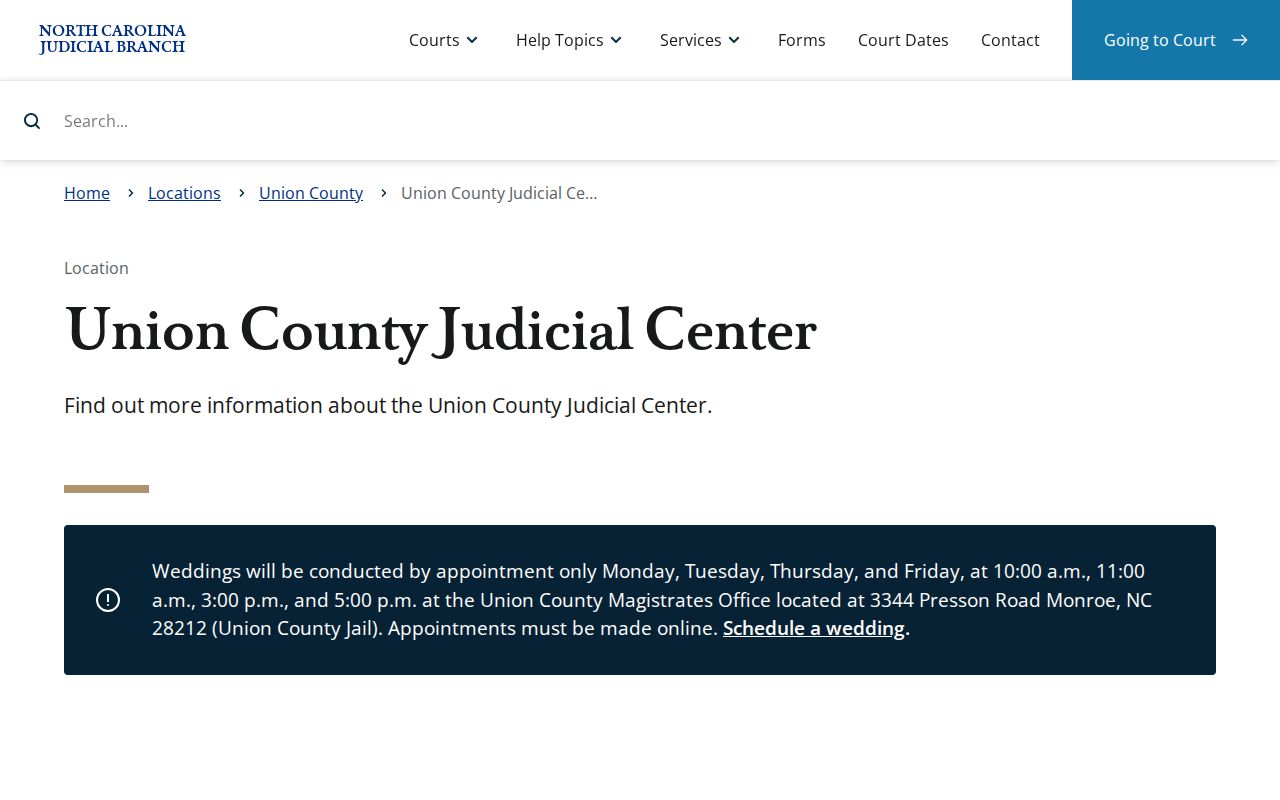
When a public Portal view needs checking against the clerk's actual case file, the Judicial Center is the local hub for that comparison.
Docket Access Under North Carolina Law
North Carolina law settles the basic model: the clerk keeps court records, files, dockets, and indexes. Those materials are generally open for public inspection during office hours unless another law or a lawful restriction applies. The rule has limits, though. It does not put every uploaded item online, and it never overrides sealing, confidentiality, juvenile, or protected-information rules. Treat any public Portal result as a convenience layer. The official record is what the clerk holds.
Key Rules:
G.S. 7A-109 requires clerks to keep court files, dockets, and indexes and provides the general public-inspection rule.
G.S. 1-72.1 sets a court-motion path for eligible civil judicial records that are otherwise unavailable.
North Carolina Public Records Act, Chapter 132 includes sensitive-information redaction protections.
G.S. 7A-308 lists clerk copy, certification, and exemplification fees.
Union County Docket Restrictions
Some Union County court records stay outside ordinary public Portal access. The Portal FAQ names the categories: sealed or expunged cases, unreturned criminal warrants, juvenile records, and certain protected-order-related materials. A blank result can also come from a spelling slip. So can a location filter, a case type, or an interface limit. It never proves a record did not exist.
Never try to dodge an access restriction. Need an official copy? An answer on a restriction, or a civil record closed to inspection? Ask the clerk about the lawful route. The path can turn on the record itself plus a court order or statute. Also avoid copying sensitive identifiers from any court display or request.
Note: Registration can unlock extra Portal features. But role-based elevated access does not lift sealing or confidentiality limits.
How the Clerk Keeps Docket Records
One office holds the keys in Union County. The Clerk of Superior Court keeps court files, dockets, and indexes across all the trial divisions. That covers civil and criminal actions, estates, special proceedings, judgments, and related court business. So there is no point hunting for separate county civil, criminal, probate, or city-court clerk offices. Staff can route a record question to the right place. They cannot give legal advice. And they cannot change a court order informally.
Union County Clerk of Superior Court
Union County Judicial Center
400 North Main Street
Monroe, NC 28112
(704) 698-3100
Questions about magistrates, judges, Family Court, arbitration, or Drug Courts get routed separately through the official directory. It helps a caller land in the correct office without implying those programs run their own public docket databases.
The Union County contact directory is the current source for those court-office routes.
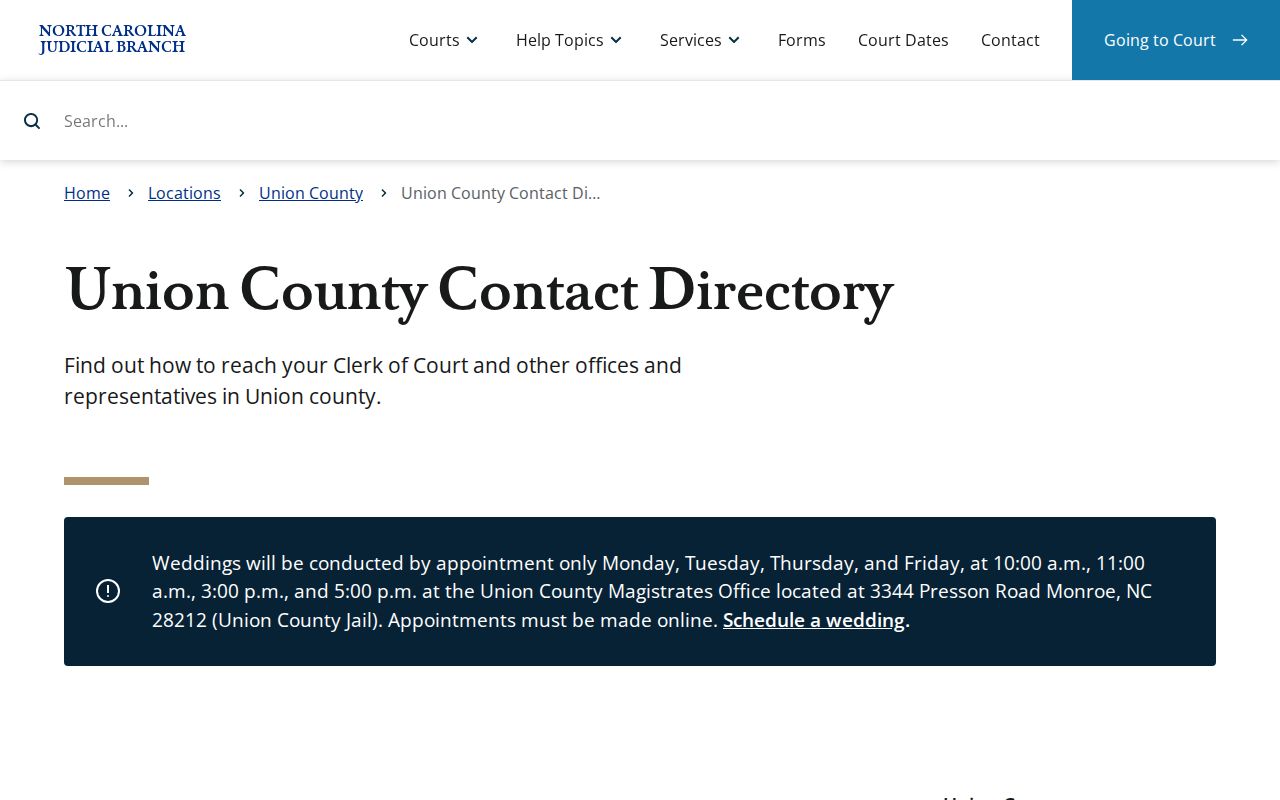
Use the directory for routing, then go to the clerk file or a live court source for any official record question.
Union County Court Docket Data
Aggregate numbers can frame a Union County court docket search, but they are not a case record. The Judicial Branch's Case Statistics Dashboard filters by county, court, case type, and fiscal year. It then exports a PDF. Report rows and dashboards shift over time. So the dashboard is the right place for a current local count. This page repeats no unverified filing or disposition figure.
Union County covers 633 square miles, with a 2024 population estimate of 263,386. That scale helps explain why one county court hub serves several large municipalities. It says nothing about caseload trends or backlog. So use the dashboard's current filters and exact metric labels whenever a number matters.
The dashboard launched in December 2025. It carries those county, court, case type, and fiscal year filters plus PDF export. A reader can reproduce the same selection. That makes it more trustworthy for a current Union County metric than a number copied from an aging report. The statewide reporting library also separates civil from criminal or infraction activity sources. Filings, pending matters, and dispositions all appear there. But keep every figure tied to its fiscal year, court layer, case category, and source label.
The Judicial Branch data and statistics page is the official entry point for current reporting.
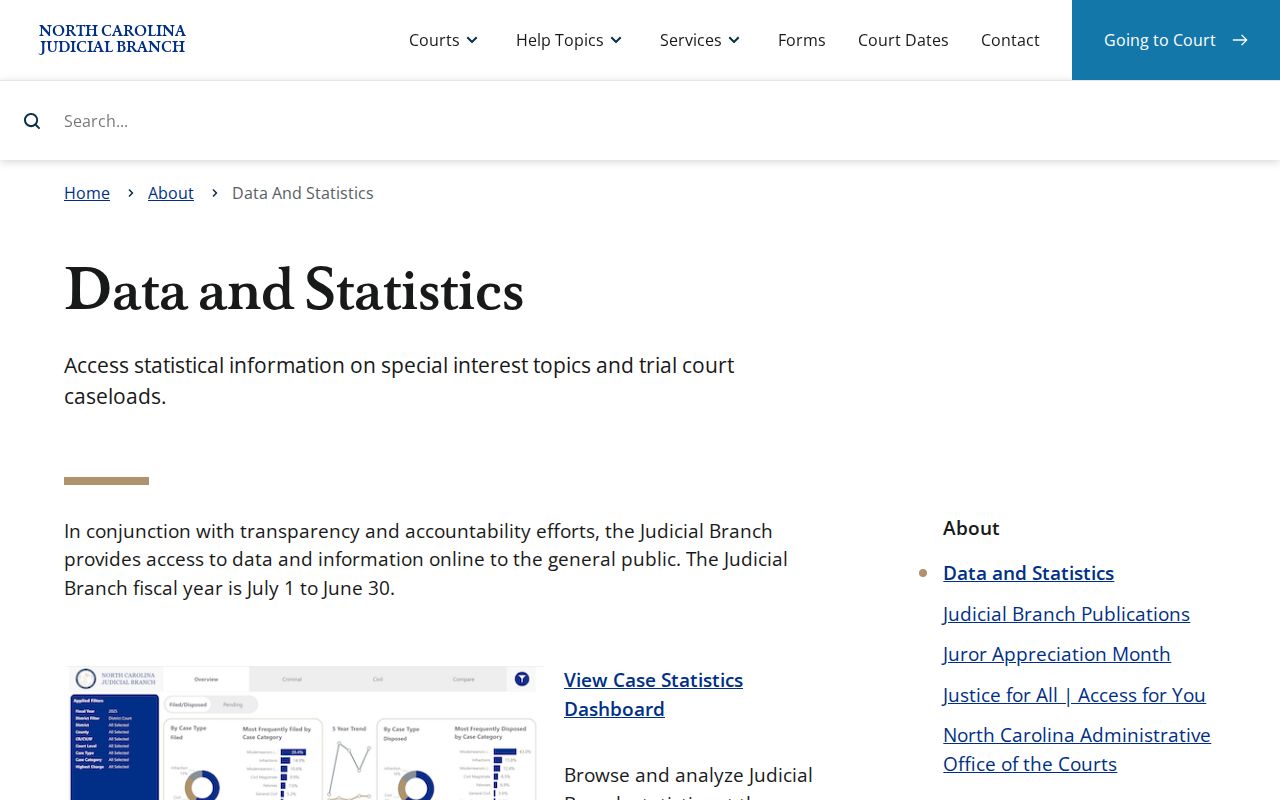
The dashboard is built for aggregate court information. It does not replace a live case lookup or a clerk record request.
City-by-City Court Dockets in Union County
Indian Trail, Monroe, Waxhaw, Stallings, and Weddington rank as Union County's five largest incorporated municipalities. The 2020 Census population determines that order. Each one runs its own town or city administration with local agency contacts. None of them operates a separate city municipal court docket for state-court cases. So court questions from any of these communities still land with Union County District or Superior Court. They also go to the Clerk of Superior Court. The North Carolina eCourts Portal handles those questions as well. That is where a Union County court docket search begins. The rule holds no matter which town the case touches.
Indian Trail Court Records
39,997 residents in the 2020 Census. Town contacts are separate from the county court route.
Monroe Court Records
34,562 residents in the 2020 Census. The active county Judicial Center is in Monroe.
Waxhaw Court Records
20,534 residents in the 2020 Census. A police payment referral is not a city court docket.
Stallings Court Records
16,112 residents in the 2020 Census. State court records remain countywide.
Weddington Court Records
13,181 residents in the 2020 Census. Town Hall is not a court-record counter.
Union County Court Docket City Routes
Which local agency wrote a citation? That search usually starts with the city police, a sheriff-contract office, or the town hall. Any of those can point you to the right administrative record. Still, none of them takes the place of a state-court case search. A citation carrying a Union County court date belongs in eCourts. Use the official Court Dates or Union calendar route. Or ask the clerk when you need an official answer. For context on the county itself, U.S. Census QuickFacts is the source behind the city ranking.
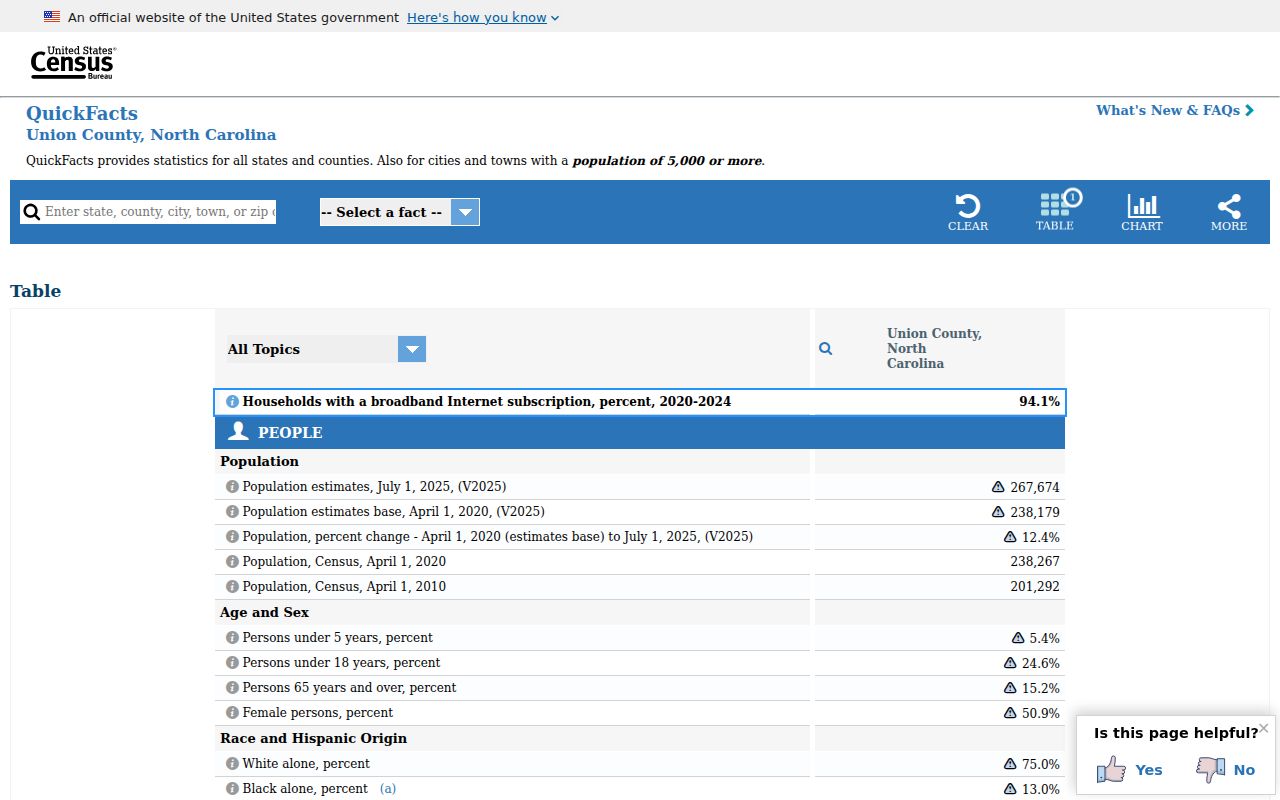
Population context: the ranking simply organizes local pages here, since the cities themselves run no separate court systems.
Union County Court Docket Court Levels
Federal and bankruptcy cases travel a different road. Neither the North Carolina eCourts Portal nor the Union County Clerk offers a federal docket search. A federal case belongs to the Western District of North Carolina. Reach it through PACER or that federal court system. Keeping the line clear saves real confusion. It keeps you from reading a state-court Register of Actions as a federal docket, or asking the local clerk to certify a federal filing. North Carolina Superior Court information describes the state trial division at the center of Union County court structure.
Superior Court sits inside the same Union County court and clerk framework, even when a case begins in another trial division.
Map and Directions to the Union County Judicial Center
Union County's Superior and District Court files, along with the Clerk of Superior Court's office, are kept at the Union County Judicial Center, 400 North Main Street, in Monroe. Monroe is the county seat, and the Judicial Center is the single countywide hub for suburbs such as Indian Trail, Waxhaw, Stallings, and Weddington, none of which run their own municipal court.
Union County Judicial Center
400 North Main Street
Monroe, NC 28112
(704) 698-3100
Monday through Friday, 8:30 a.m. to 5:00 p.m.
The Judicial Center added public eCourts kiosks in June 2025 for Portal access, e-filing, payments, scanning, and printing, though the exact kiosk floor and any parking or security-screening rules are not published. Call (704) 698-3100 before a visit to confirm current building access.