
How the Union County Court Calendar Works
Union County sits inside the statewide trial court system, and its calendars reflect that structure. Several official routes exist. There are county-filtered criminal and civil session listings. There are also the statewide Court Dates service, and hearing results in the North Carolina eCourts Portal. Each one answers a scheduling question. The Register of Actions, called the ROA, answers a different question. It is the public chronology of a single case.
Division matters too. Misdemeanors and infractions generally start in District Court in Union County. Felonies generally belong to Superior Court. A District Court criminal or infraction appeal also moves up to Superior Court. Read the actual court assignment and hearing type from the live record. Guessing from a broad case label is risky.
Neither the Portal nor a calendar is a certified record. The Union County Clerk of Superior Court confirms settings. It handles copy requests, and answers questions about records that do not appear online.
Union Court Calendar Routes
Match the route to the question you are asking. The Union criminal calendar filters criminal sessions to the county, and the Union civil calendar does the same for civil sessions. For a lookup that spans the state, Court Dates is the service to use.
| Question | Most useful live route | What it supplies |
|---|---|---|
| When is a criminal session? | Union criminal calendar | Current county-filtered session information. |
| When is a civil session? | Union civil calendar | Current county-filtered civil session information. |
| What hearing is tied to one case? | Portal Hearing Search or case ROA | Case-focused hearing data where present. |
| How can a court date be checked statewide? | Court Dates | Official statewide date-search guidance. |
| What is the official local answer? | Union County Clerk of Superior Court | Clerk-directed scheduling and record confirmation. |
Reopen the route whenever the date truly matters. A calendar line you copied earlier can go stale after a scheduling change.
Union County Court Date Lookups
Pick the channel that fits the confirmation you need. The Portal offers public case and hearing search tools. The criminal and civil calendar links list current Union County sessions. Court Dates covers the whole state. For local access, the clerk's counter and public terminals at the Judicial Center work when an online display is unavailable or the record needs a closer look. Callers can reach the main clerk and courthouse line for routing.
- Start with a current case number, citation number, or the exact party name when one is known.
- Check Smart Search or Hearing Search in the eCourts Portal, using Union location and a narrow date range where the live screen requires them.
- Open the appropriate Union criminal or civil calendar for a session-oriented check, or use Court Dates for the statewide route.
- Compare the result with the case ROA if one is publicly available; an ROA is a chronology, not the calendar itself.
- Call or visit the clerk for an official confirmation, an unavailable record, or a same-day court question.
The North Carolina Court Dates service is the source shown in this official image.
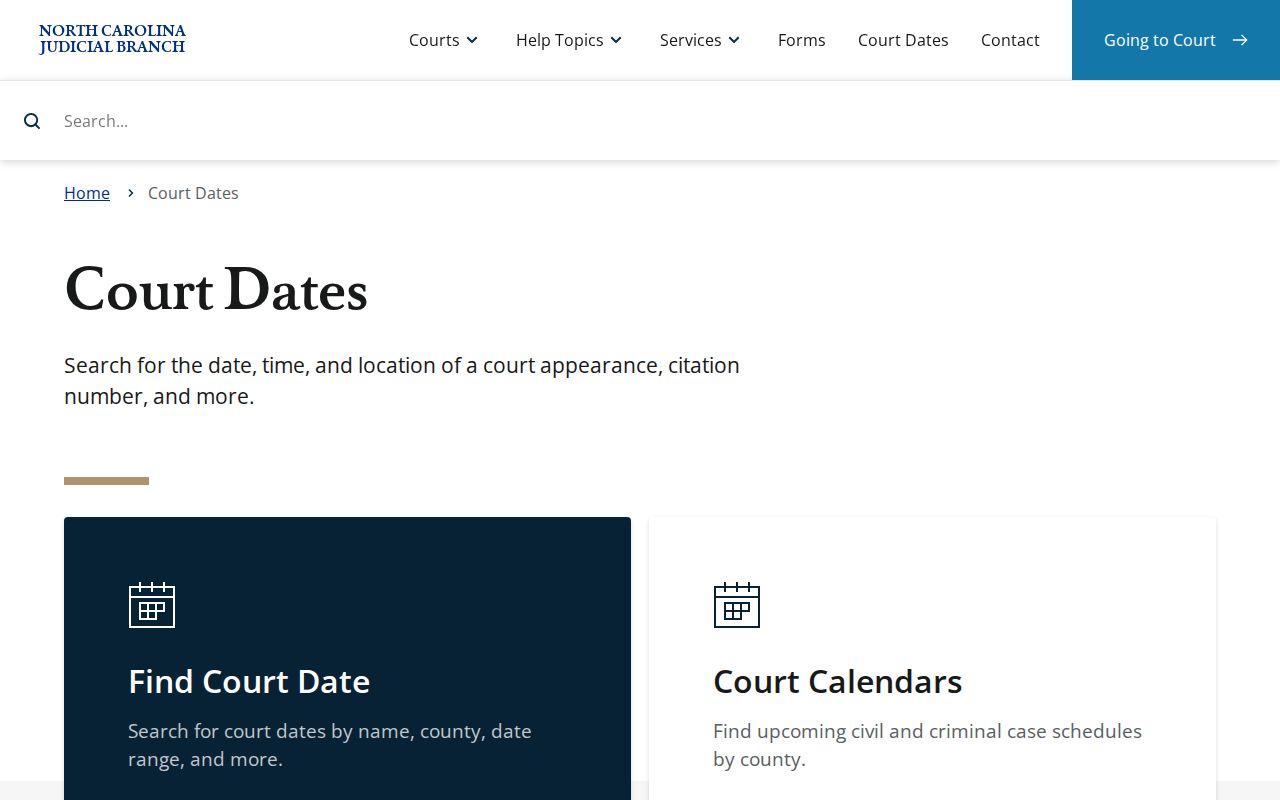
Treat the state lookup as a live service, not a saved page. When a Union County setting must be relied upon, confirm it with the clerk.
Union Court Calendar Hearing Filters
Portal Hearing Search is not the same tool as Smart Search. The official guide lays out several choices. These cover Location, Hearing Type, Search Type, and From and To dates. A focused Union location with a narrow date range usually beats a broad statewide query. The live Union County screen controls which field is required. That field depends on the search type you pick.
- Location
- The court or county filter used to narrow a statewide hearing search to Union where available.
- Hearing Type
- A documented category that includes All Hearing Types, Civil, Criminal, Family, Probate, or Mental Health.
- Search Type
- The selected method for a case number, party, business, attorney, attorney bar number, judicial officer, or courtroom query.
- From / To dates
- The date range that limits a hearing query to a useful scheduling window.
A Union County hearing listing is calendar information, nothing more. Confirm with the clerk or the official calendar, because a setting can move after any display is checked.
Court Settings: What Each Field Means
A Union County court setting is a scheduled event entry. Its fields vary by calendar or Portal result. None of them is guaranteed to appear. Read the full live line before making plans. A time shown for a session, docket call, or hearing is not a promise that the event will proceed unchanged.
| Date | The scheduled calendar date shown in the live result. It can change because of court or weather scheduling. |
|---|---|
| Time | The time displayed for a session or hearing. Confirm the current meaning with the clerk when appearance timing matters. |
| Location | The court or county location field used to identify where the setting belongs. |
| Courtroom | A hearing-location field that can appear in a calendar or Portal result. |
| Judicial officer | A field used in Portal hearing search and associated hearing context where shown. |
| Hearing type | The event classification, such as Civil or Criminal, selected or shown in the live scheduling tools. |
Case reference and session context can show up as well. They help identify the setting, but they cannot replace the official file or resolve every procedural question.
Union Court Calendar and ROA
Two Union County public views can describe the same matter without being interchangeable. The calendar is an event and session list. The Register of Actions is a case-level chronology, labeled Case Summary in the Portal. A calendar tells you about a current setting. The ROA can show public case events, hearings, dispositions, and other sections where data exist.
Reach the ROA through Union County Docket Search. An exact case number identifies the matter. A precise party-name query can too. Then go back to a live hearing result or calendar for date-oriented confirmation. Remember that the Portal is not the official court record. A certified copy or a correction-sensitive answer still comes from the clerk.
Keeping the two views separate prevents a common mistake. A session list is not the complete case file. An older ROA hearing entry is not a promise that the session never moved.
When a Court Date Moves
Court dates in Union County shift all the time. Weather, a continuance, a cancellation, or plain scheduling congestion can move a hearing. The Court Dates service warns as much. It sends you to the clerk to confirm any setting. If a date drops off the calendar you pulled up, don't read anything into that. It is not a sign of how the case ends.
Trust the live source, not what you saved earlier. An old result can go stale fast. A text message about your hearing can too. Both may be stale by the time you act on them. Pull the current ROA and Hearing Search entries and compare them for your case number. Still unsure about the next date, the room, or a requirement the court imposed? Call the clerk. That office holds the official file and can route you to the right answer.
Note: Treat it as an open scheduling question. A continuance or reset stays open until the Union clerk or the current court record confirms the new setting.
Union Court Calendar Confirmation
Union County court activity centers on one building. The Union County Judicial Center houses both Superior and District Court operations. It also holds the Clerk of Superior Court. The building sits at 400 North Main Street, Monroe, NC 28112. Public hours run weekdays from 8:30 a.m. to 5:00 p.m. The Judicial Branch lists those hours. The general courthouse number is 704-698-3100. A call ahead can confirm the docket or hearing you plan to attend.
Union County Clerk of Superior Court
Union County Judicial Center
400 North Main Street
Monroe, NC 28112
704-698-3100
Weekdays, 8:30 a.m. to 5:00 p.m.
The clerk's office also offers public terminals for record searches. You can look up criminal and civil matters there. Search by name, case number, or even witness name. Union eCourts kiosks were announced with Portal access, printing, scanning, e-filing links, and payment services. Where the kiosks sit is a detail the clerk can confirm before your visit. So is whether a daily printed Union calendar exists. Asking ahead saves a trip when you need a court docket on paper.
Union Court Calendar Local Rules
Union County's procedural materials live in one place. That place is the Union County local rules and forms index. The index collects local rule documents and the Union County Bond Policy. Check the live index before counting on any local procedure. Documents and notices change without much fanfare.
The bond policy took effect December 1, 2025. It offers pretrial-release context. It also references certain hearing requests within 10 business days in District Court and 21 business days in Superior Court. Those numbers do not create a general calendar timeline. Nor do they promise any particular hearing result.
The county's contact directory also lists a Drug Courts route. That contact is the right way in. But Union County publishes no public specialty-court calendar, and individual program records stay closed to the public.
Missed Settings and What Comes Next
Miss a Union County court setting? Act on it quickly, and in the specifics of your case. If the Portal hearing result, calendar, and ROA are publicly available, check them first. Then contact the clerk for the proper court route. If you have a lawyer, call that attorney too. An online calendar entry will not explain the consequence or hand you a replacement date.
Missed setting warning. A missed criminal court date can lead to a failure-to-appear process or other case consequences.
The current court record and clerk are the sources for the next required action and any confirmed date.
For a legal question about a missed Union County setting, seek advice from a licensed attorney rather than relying on a calendar display.
Union County traffic matters carry statutory consequences for a failure to appear or pay. Those kick in only after the required notice process. Paying is not a stand-in for showing up, so confirm your eligibility, the deadline, and the court's direction through the official case channels.